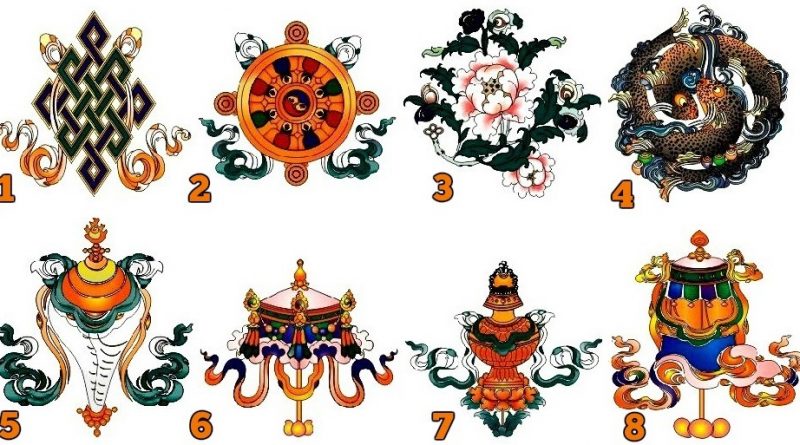
 Signs of good fortune have been established in Hindu mythology since ancient times. Tibetan Buddhism has a group of eight symbols that are considered to be the oldest and most well known.
These eight symbols include the Golden Fish, the Parasol, the Run, the Lotus Flower, the Conch Shell, the Infinite Knot, the Wheel, and the Flag.
1. The Infinite Knot
 Dharma is continuous and inexorable, while Time is but an illusion. The Knot of Infinity symbolizes that truth. The search for enlightenment need not mean giving up worldly responsibilities.
The Knot is a representation of the Buddha’s teaching that religious thought and material life are intertwined.
The Infinite Knot is a line without a beginning or end that radiates both calm and movement. It represents the idea that everything in this world is interconnected.
It is also symbolic of the Buddha’s infinite compassion. Originally, this symbol was associated with Vishnu and his abiding love for his consort Lakshmi, goddess of wealth.
You can find the endless knot symbol on various inspirational products such as endless knot pendant, endless knot decor and more.
2. The Wheel
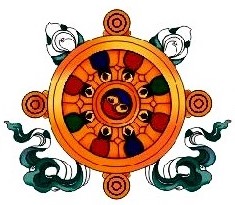 The eight-spoke wheel Dharmachakra (chaos kyi in Tibetan), also known as the Wheel of Law is among the oldest and best known of Buddhist symbols, going back to the time of the great Buddhist king Asoka in India.
The wheel in its entirety encapsulates the Buddha’s teaching. Its eight spokes represent the Buddha’s Noble Eightfold Path, which leads to the spiritual enlightenment of all sentient beings.
The circular shape invokes the idea of perfection – following the path of dharma is the best way out of the endless cycle of samsara. The hub of a wheel is its focal point. Here, it stands for inner discipline which is the essence of meditation practice.
Recommended: Choose One Golden Crystal Mandala To Receive A Message From Your Higher Self
The rim of the wheel connects the spokes and holds together the entire structure. This is mindfulness (Samadhi) or ‘living in the moment’ a cornerstone of Buddhist teachings.
The forward motion of the wheel points to the spread of the Buddha’s doctrine. Ever since Sakyamuni expounded on his doctrine of enlightenment, the Wheel of Dharma has never stopped rolling, from India through virtually all of Asia and in modern times, the West as well. Many Asian countries have incorporated the Dharmachakra into their national flags.
3. The Lotus Flower
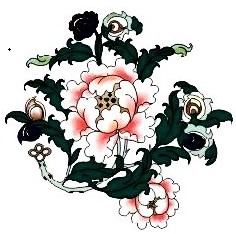 The lotus is called the Padma in both Sanskrit and Tibetan. Rooted in muddy slime, the lotus rises through water to emerge into the sun, a progress that mirrors the journey of man’s soul.
Mired in suffering and sin, we pass through varied experiences before emerging into the sun of enlightenment. Many plants grow above water; it is only the lotus whose sturdy stem allows it to clear the water surface and stand steadfast.
It is said that our hearts are like the closed petals of a lotus. Imbibing Buddhist virtues will enable the lotus to blossom into its full beauty. This is why the Buddha is often depicted seated on a lotus.
The white lotus represents the purity of mind and an evolved spirit. The pink lotus is matchless in its perfection and therefore emblematic of the Buddha himself. A blue lotus is symbolic of the spirit’s conquest of the senses, while a red bloom is associated with Avalokiteshwara, the Compassionate One.
4. The Golden Fish
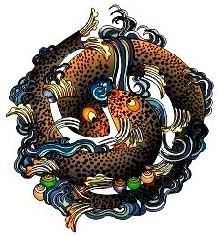 As human beings, we must live through samsara, or the endless cycle of birth, death, and rebirth that entails suffering at every stage.
The Buddha’s teachings set us on the path to liberation from samsara; the golden fish is a symbol of that liberation, a creature of joy, at one in its element, living a life of spontaneity with no pain or fear of perishing in self-created suffering.
The fish symbol is significant in Hinduism, Jainism, and Christianity. In Buddhism, the fish also represents fertility and plenitude.
Recommended: Which Magical Chalice Would You Drink From?
It is often beautifully depicted as a carp, which in Asia is considered sacred because of its elegance, size and long lifespan.
Essentially, the golden fish is an aspirational symbol, teaching man that the spiritual bliss which lies beyond samsara is infinitely more beautiful than anything he can experience in earthly life.
5. The Conch Shell
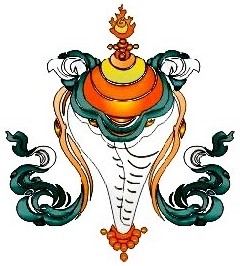 A right-spiraled conch is a rare find and is considered sacred in Buddhism. Its direction is thought to be consonance with the movement of celestial bodies in the universe.
Curiously, the whorls of hair on the Buddha’s head are right-directional; so is his body hair and the curl between his eyebrows. His navel too is shaped like the right-turning conch shell.
Today, the conch is used as a summons to prayer. During rituals, it is used to hold holy water and as a musical instrument.
The conch proclaims the widespread influence and sovereignty of Buddha’s teachings. It is emblematic of great spiritual power and its resonance is thought to cast out evil spirits.
6. The Parasol
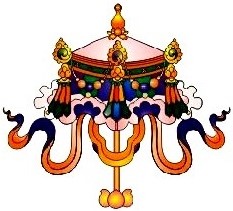 In nature, the dome of the sky arches above the mountain. The parasol in Buddhism is symbolically a device which casts a shadow, and therefore, offers protection from heat. Also, in Indian mythology, the parasol has traditionally been associated with royalty.
Held above the head, it conveys honor and reverence, and hence the Buddha is often depicted sitting under a decorative parasol.
The concept of the parasol providing shelter from the sun’s heat translates into the Buddha’s teachings protecting us from the “heat” of negative forces like greed, lust, and suffering, obstacles in the path of the spirit’s journey towards enlightenment.
Recommended: Choose One Crystal Ball To Receive Your Message From Spirit For The New Year
The Tibetan parasol is inspired both by Indian and Chinese designs used by royalty. Its wooden spoke is topped by a dome-shaped cover, with a silky “skirt” hanging from the rim. The dome represents wisdom and the skirt, compassion, both of these being essential Buddhist values.
7. The Urn
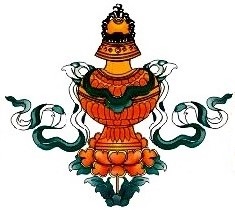 The urn closely resembles the round-bellied, slim-necked Kalash of Hinduism. A large jewel on top gives the urn its other name, the Vase of Treasure. The urn is symbolic of limitless wealth.
Traditionally, Buddhist treasure vases are filled with sacred materials and placed upon altars. They are buried near springs and mountain passes in the belief that they are conducive to a harmonious environment. It is believed that their presence attracts wealth.
Of greater significance is that the urn represents the abundant spiritual wealth of the Buddha. No matter how much he gives away, more will always be forthcoming.
8. The Flag
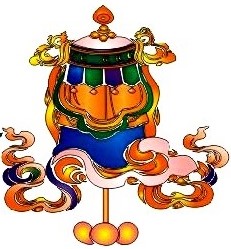 In Hindu mythology, the flag or Banner of Victory is often featured as a military standard. In Buddhism, it is emblematic of the conquest of ignorance.
It is also symbolic of the Buddha’s triumph over the four Maras, or obstacles on the path to enlightenment. These are passion, greed, emotional degradation and the fear of death. To achieve enlightenment, all sentient beings must conquer these hurdles.
Traditionally, cylindrical banners made of beaten copper are placed at the four corners of Buddhist temples. They point to the spread of Buddhist doctrine in four directions and the Buddha’s victory over the Maras.
These Eight symbols appear throughout Buddhist iconography both separately and all together. At Buddha Groove, you’ll find these symbols beautifully adorning jewelry pieces, home décor, and various tools for spiritual rituals.
Choose from sterling silver pendants- one for each of the eight symbols-or browse wall hangings featuring artistic depictions. You’ll also find bracelets lined with the symbols as well as traditional singing bowls and prayer wheels crafted with Auspicious Symbol reliefs.
Source: mssnaturalbeauty
Bis Juni 2010 befand sich im Hotel eine ESPN-Zone, die von der Straße und vom Casino
aus erreichbar war. Das Theater ist als Kabarett eingerichtet, mit Sofas und Barhockern als Ergänzung zu den Standard-Theatersitzen. Anstatt
einen solchen bargeldintensiven Kauf zu tätigen, stimmte MGM
jedoch zu, Primadonna für 276 Millionen Dollar an Aktien plus 336 Millionen Dollar an Schulden zu kaufen. Die japanische Firma Universal Distributing
besaß das Grundstück und hatte ein Joint Venture mit den Promus Companies zum Bau
eines Hotelcasinos diskutiert, konnte aber keine Einigung erzielen.
Stattdessen ist es über Fußgängerbrücken mit den benachbarten Casinos im Süden (Excalibur, über die Tropicana Avenue) und im Osten (MGM Grand) verbunden.
Der Hauptcasino-Bereich zum Beispiel ist nach dem Times Square benannt, während die Restaurants nach dem Vorbild von Greenwich Village gestaltet sind.
Ja, das Hotel verfügt über eine Reihe von ADA-konformen Zimmern und Suiten in den meisten Türmen, mit visuellen Alarmen und
zugänglichen Armaturen. Die New York Pizzeria bietet das typische NYC-Pizza-Erlebnis, während das Il
Fornaio und der irische Pub Nine Fine Irishmen ebenfalls sehr beliebt sind.
Das Frühstück kann im Restaurant America eingenommen werden, das gekochte
Frühstücksteller ab 9,99 $ (7,50 £) sowie eine umfangreiche Speisekarte anbietet.
Das kleine Fitnesscenter verfügt über Laufbänder, stationäre
Fahrräder und Treppenstepper sowie Krafttrainingsgeräte.
Der Full-Service-Salon bietet nicht nur Haar- und Nagelpflege, sondern auch Spray-Tanning und Make-up-Anwendungen.
References:
https://online-spielhallen.de/locowin-casino-deutschland-dein-umfassender-guide/
After I originally left a comment I seem to have clicked the -Notify me when new comments are added- checkbox and now each time a comment is added I receive four emails with the same comment. Perhaps there is a way you are able to remove me from that service? Thank you!
Thanks for ones marvelous posting! I genuinely enjoyed reading it, you could be a great author.I will make sure to bookmark your blog and may come back later in life. I want to encourage you to ultimately continue your great job, have a nice holiday weekend!
Hello there, You have performed an incredible job. I will certainly digg it and in my view recommend to my friends. I’m sure they’ll be benefited from this web site.
Right now it looks like Expression Engine is the preferred blogging platform available right now. (from what I’ve read) Is that what you’re using on your blog?
At this time it appears like Drupal is the top blogging platform available right now. (from what I’ve read) Is that what you’re using on your blog?
Greate pieces. Keep writing such kind of information on your blog. Im really impressed by your blog.
Just desire to say your article is as astounding. The clearness in your post is simply great and i can assume you are an expert on this subject. Fine with your permission let me to grab your feed to keep updated with forthcoming post. Thanks a million and please continue the enjoyable work.